Showing posts with label Rwanda sustainability. Show all posts

Thursday, December 1, 2011

A Rubona Sector Almanac


“There are some can live without wild things, and some who cannot. These essays are the delights and dilemmas of one who cannot.” Aldo Leopold, in the forward to A Sand County Almanac

Aldo Leopold used basic interactions between plants, animals, soils, water, and weather on his farm in Wisconsin to illustrate the complex web of ecology in A Sand County Almanac. In homage to his most famous writing and my favorite book, I compiled a few brief observations over the past year from each month to celebrate a small piece of land in the Rwandan countryside. 

Leopold started with the awakening of a slumbering skunk in the first mid-winter-thaw in January and finished the month-by-month progression with the birds struggling to grapple with the colds of December. In Rwanda, which has a small temperature range all year round, the seasons are less clear. There is a distinctive dry season (June-August) and a distinctive wet season (September-November), but the rest of the time, it is just less wet and less dry. For those of you interested in the wild things in your backyard, this is a snapshot of a few wild things in my backyard this past year, a rural hillside in Rwanda.


December

You wake up in a fog. There are hills flowing over the earth’s crust in every direction but you might as well be anywhere. The birds are timid in the fog and you can get closer to them than usual, if only you could see them clearly. Unless rains come, the sun will bake off the fog within an hour. It feels hot by 8 AM, but the equatorial sun is mitigated by our elevation of 1,550 meters (about 1 mile). 

Friday, November 11, 2011

Art and science collide!

Binoculars. Colored pencils. Early mornings. Rough drafts. In a world full of birds, art and science combine to make bird knowledge accessible.

Red-eyed dove - Streptopelia semitorquata - Inumah

Agahozo-Shalom is rich in birds, and now its students can learn about them with a new poster illustrating more than 30 of the most common species.

The poster features drawings and the names of the birds in English, Latin (scientific), 
and Kinyarwanda. One of Rwanda's top bird guides (who is a native Kinyarwanda 
speaker) helped us to find the local names. A student artist completed 26 
of the species while Michele (the art teacher) completed 7 species. The poster is 
shown here in lower resolution because it is not yet ready for distribution.


Meet the artist: Rossi, a 9th grade student at ASYV, drew most the birds.
He was president of the student art club and spent his free time on
Saturdays and Sundays illustrating our feathered friends.

Friday, October 28, 2011

Saturday Service and the spirit of umuganda

You won't find a business open or a bus running from 7 am to noon on the last Saturday of the month in Rwanda. Instead, you will find nearly every citizen over 18 engaged in the community service program called "umuganda."

Agahozo students pose with the litter they cleaned up at a Saturday
Service event.

At Agahozo-Shalom Youth Village, we practice umuganda in a slightly different way. Every Saturday (and on Sunday for 7th Day Adventists), students participate in village-wide community service projects. One of my roles here this past year has been to coordinate these "Saturday Service" events.

Monday, October 24, 2011

Bringing the sausage tree to Agahozo

The sausage tree is found in a variety of habitats, including the open
plains of Serengeti National Park, Tanzania.


The sausage tree is a prominent tree of the African landscape. It is native to sub-Saharan Africa and can be found in nearly every country in that range. But you hardly see them in Rwanda.

The tree gets its English name because its fruits resemble giant sausages.
This picture is from one of the only Kigelia trees I have seen in Rwanda.

Kigelia pinnata is found in the surrounding countries Democratic Republic of the Congo, Uganda, Tanzania, and Burundi in savannahs and woodlands from 1100-3000 above sea level (I have seen it in both Uganda and Tanzania). Despite having the elevation and (at least formerly having the) habitat, I have only seen a few individuals of this species in Rwanda, all near the shore of Lake Muhazi, but I would guess it can also be found in Akagera National Park.

Monday, October 3, 2011

A birthday with gorillas

The dominant male silverback gorilla is singing HAPPY BIRTHDAY
to me in his loudest voice. Ok, he's actually just yawning.

It is nearly 11 am, and we have been hiking up the side of an ancient volcano for nearly two hours. As Michele, myself, a group of six others, and a guide clamber through stinging nettles, bamboo, and mud, my eyes light up and I grab Michele's hand.

There they are…

Wednesday, September 28, 2011

Alien invasion!

Flowers of Lantana camara. Look closely- each one of those blooms is
a small flower on a bigger 'head.' Each head can have up to 20 flowers.

I have met the enemy, and its name is Lantana.

Lantana camara is a plant species originally from Central and northern South America. Sixty years ago this beautiful plant was still in its native range, but it was taken to Europe as an ornamental. People then took it around the world, and now sixty countries or major islands are grappling with its effects on their ecosystems.

Lantana thick and tall in Agahozo-Shalom Nature Park, 7:30 am one morning.
You can barely make out the tree inside.

Lantana is all over East Africa (Kenya, Tanzania, Uganda, Rwanda, Burundi). On our hillside in Rwanda, outside of landscaped and cultivated areas, Lantana is the dominant plant. You pass it on the way to the dining hall and school, you sit near it in the amphitheater, and you see it in Parike W’Agahozo (Agahozo-Shalom Nature Park). In the park especially, where we are promoting the growth of native species, Lantana is a major problem; it is a non-native (alien), invasive species.

The same view of the tree as above five hours later with Lantana removed.
There is still more to remove from the back and sides, and several stumps
still need  to be removed. Clearing Lantana from this tree was particularly
tricky because there are swarms of honeybees that live in it!


Monday, September 26, 2011

She spoke for trees and people: In Memory of Wangari Maathai

The world just lost one of its greatest environmentalists. Wangari Maathai, a Kenyan woman who started the Greenbelt Movement, died yesterday.

A snapshot of Greenbelt Movement's home page today

I never met Wangari Maathai, but she had a profound influence on my understanding of what I think this world needs and how we should go about doing it. She will be remembered and indeed, her work will live on if we continue to live better through environmental stewardship.

Monday, September 5, 2011

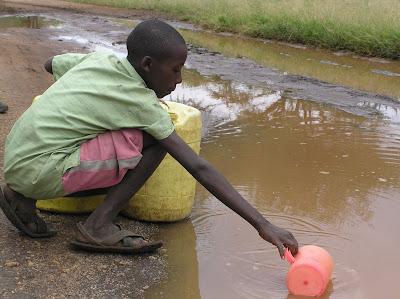
Water Woes in East Africa

A boy collects water from rain puddles in northern Tanzania.

Turn on your tap. Use the water. If you can do that, you are safer than hundreds of millions of people in Africa.

Tuesday, August 30, 2011

Eating lower on the food chain

The bounty of last Friday's market trip. Can you believe I got all this
for four dollars and 8 cents? (2450 RWF total, 1650 for the fruits
and vegetables and 800 RWF for the beans)

We are consumers, make no mistake about it. We have to eat. Food at its most basic is chemical energy, transformed by plants from sunlight, that our bodies transform into kinetic energy. It also supplies us with the building blocks for all of our cells and a variety of other essentials. But let us not think in such scientific terms for now. What about taste? What am I eating in Rwanda?

Sunday, July 10, 2011

Welcome to Agahozo-Shalom Nature Park!

Murakaza neza ku Parike Y'Umutungo Kamere W'Agahozo! What in the world does that mean? It means that you are about to enter a brand new nature park.

The Environment Club poses by the sign marking the park. Students have
worked on every aspect of the park, including making these signs,
surveying flora and fauna, and removing invasive species. 

This will be the first of several posts about a special project: a student club has adopted a piece of land and turned it into the Parike Y'Umutungo Kamere W'Agahozo.

What is Parike Y'Umutungo Kamere W'Agahozo?

Monday, June 27, 2011

Happy Environment Day from Agahozo!

This past Saturday, Agahozo-Shalom Youth Village celebrated Rwanda's Environment Day. The Environment Club and its two sponsors (a woman named Anne-Marie and myself) coordinated the day's events, which included tree plantings, speeches, and a movie.

Two students and their housemother planted an acacia tree in their yard
 for Rwanda's Environment Day. When fully grown, this tree will be great
 for wildlife and for shade.

We started the day with over 50 people working on our new nature park and trail and gave the inaugural tour to some visiting donors (the park and trail will be covered in an upcoming post). Then we hosted an after-lunch event, where we screened a fun environmental film, heard from four speakers about water and trees, and explored environmental issues at an Idea Marketplace. This event attracted more than 250 village residents, including 220+ students and over 30 staff/volunteers. Finally, we planted 34 trees, including 11 acacia, 20 papaya, and 3 guava. Please enjoy the pictures of our version of Earth Day!

Thursday, June 23, 2011

Agahozo staff members learn to fly!

To understand another person's perspective, sometimes you have to step into their shoes. To understand the world of birds, you might just need to sprout some wings and fly. On June 8, I helped the staff of Agahozo-Shalom see our planet and our village from a bird's eye view.

Agahozo-Shalom staff and volunteers act the part of birds in the
migration challenge.

Thursday, March 31, 2011

ASYV: Over 100 species and counting!


Agahozo-Shalom Youth Village is a good place to watch birds. Several visitors from the United States and Israel and about 20 of the Rwandan students have participated in bird walks so far. There are many birds to see, and part of my job is to keep track of them. 


Students at ASYV are using binoculars and
thinking critically about how to find and identify birds.

I have surveyed birds here from about 6am-8am on average about four days a week since early December, totaling just over 149 hours on 69 days. Although I love bird watching, it is not all fun and games. Surveying involves getting up regularly at 5:30 am before sunrise, getting bitten by ants at least once a week, soaking my shoes/sandals each day while walking through the thick morning dew, meticulously taking notes, and lugging a camera or computer around for documentation. I also have to transform my notes into electronic form.  Data entry is absolutely necessary for keeping an inventory, but it is the most boring part of the job.


The amazing Ross's Turaco! You can see the bright
yellow face and bill and the red mohawk well. You can
sort of see the bright blue/purplish color its body. What
you cannot see is the bright red patches on its wings,
only visible when in flight. I have seen this species 
(Musophaga rossae) at ASYV 6 times, only in the 
undeveloped area behind the school. 


So far, I have identified 115 species of birds that live on or have visited the 144 acres of ASYV property, with another 6 birds narrowed down but not to the species level. To put this in perspective, around 17% of the birds found in Rwanda or about 1% of the world’s birds can be seen right here in this small space.


The African yellow white-eye, Zosterops senegalensis, is a
delightful little bird.

About 87% of the 115 birds have been spotted at least twice; only 15 birds have only a single record. For example, I have found the violet-backed starling only once (although there were four individuals present that day, 1 male and 3 females). In contrast, I have seen the very-easy-to-see pin-tailed whydah on all 69 days.

A male violet-backed starling, Cinnyricinclus leucogaster,
was quite an exciting find!


Birds from 36 families have visited or live at ASYV (add to that families of two birds as-of-yet unidentified, woodpeckers and nightjars). Remember, a family is a grouping of organisms in the Domain-Kingdom-Phylum-Class-Order-Family-Genus-Species taxonomic system. Among the families (which are in parentheses), there have been six species of sunbirds (Nectariniidae), 7 species of dove/pigeon (Columbidae), 9 species of martins/swallow (Hirundinidae), 10 species of waxbill (Estrildidae), 11 species of Accipitridae birds of prey (not including the two birds of prey from Falconidae), and 11 species of weavers (Ploceidae). 


This male scarlet-chested sunbird, Nectarinia
senegalensis
, is as pretty as they get. The turquoise
on the head is not always seen and this is the only
photograph I have that captures the head color.
Visiting ASYV? You have a good chance of seeing it,
as I have recorded it more than 1 out of every 2 days.

Six species remain elusive: a woodpecker has been spotted twice, a swift that defies my dichotomous key, a female cuckoo that has only been around once, an Aquila species of eagle, a black-faced bird of prey, and a nightjar. Most of these birds have been visible for just a short glimpse, or I have yet to see the details I need to make an identification. I have also heard of an owl that people have seen, but it has not been reported in months and I have yet to see any trace of it. 


The spot-flanked barbet, Tricholaema lacrymosa, is one
of two species of barbets I have found at ASYV.
Neither species is common on the property; I have only
three records for this species.


Is all this information for the birds? Of course not. It is important for several reasons. First, it serves as a pool of data for student use. The sciences and mathematics are major fields in Rwanda; the analysis and the process of gathering the data provides students with hands-on experiences. It also allows students to learn the techniques and methods of finding and identifying birds. For future park rangers, tour guides, and biologists, they can gain skills they need to be competitive for good jobs. Second, it gives ASYV an important tool for attracting tourists. Rwanda has a lot of potential as a birding destination and having an established bird list (plus a lodge and proximity to Akagera National Park) will capture the attention of birders and tour operators. Third, it allows the students, staff, and visitors to appreciate the natural capital present at ASYV. Although many rural people here have a recognition of some of the birds, they have yet to see many of the wonders up close or understand their full ecological roles (this is based on my conversations and observations). Furthermore, people from the city who now live at ASYV have little recognition of the birds at all or their importance (much like America and probably everywhere else).


Cinnamon-chested bee-eaters, Merops oreobates, 
live at ASYV and are a pretty regular bird
 in the undeveloped area behind the school. 
Yes, they do eat bees, and they catch them 
spectacularly while in flight.


In the coming months, I will devote posts to the most common birds, most unusual birds, the breeding birds, and peoples’ interaction with our feathered friends. In the meantime, I hope you enjoyed pictures of some of my favorite birds at Agahozo.

Saturday, March 12, 2011

Building the Future

One of the important tasks we have at Agahozo-Shalom Youth Village is preparing our students for life after high school. Some students will go to university while others will enter the workforce. In a country with many people and fewer jobs, skills are of utmost importance.

Two senior four (10th grade) students finish building shelves

Students entering the workforce without specialized skills may have to settle for a job with lower income. For example, in the construction industry, the lowest rung of employment is the porter. Porters make around 1000 RWF per day (about USD $1.68). A porter may do any number of things such as cut wood or haul stones; it is extremely hard work. A carpenter, however, may make 2500 RWF per day (about USD $4.20). Clearly, having specialized skills is an advantage to our students.

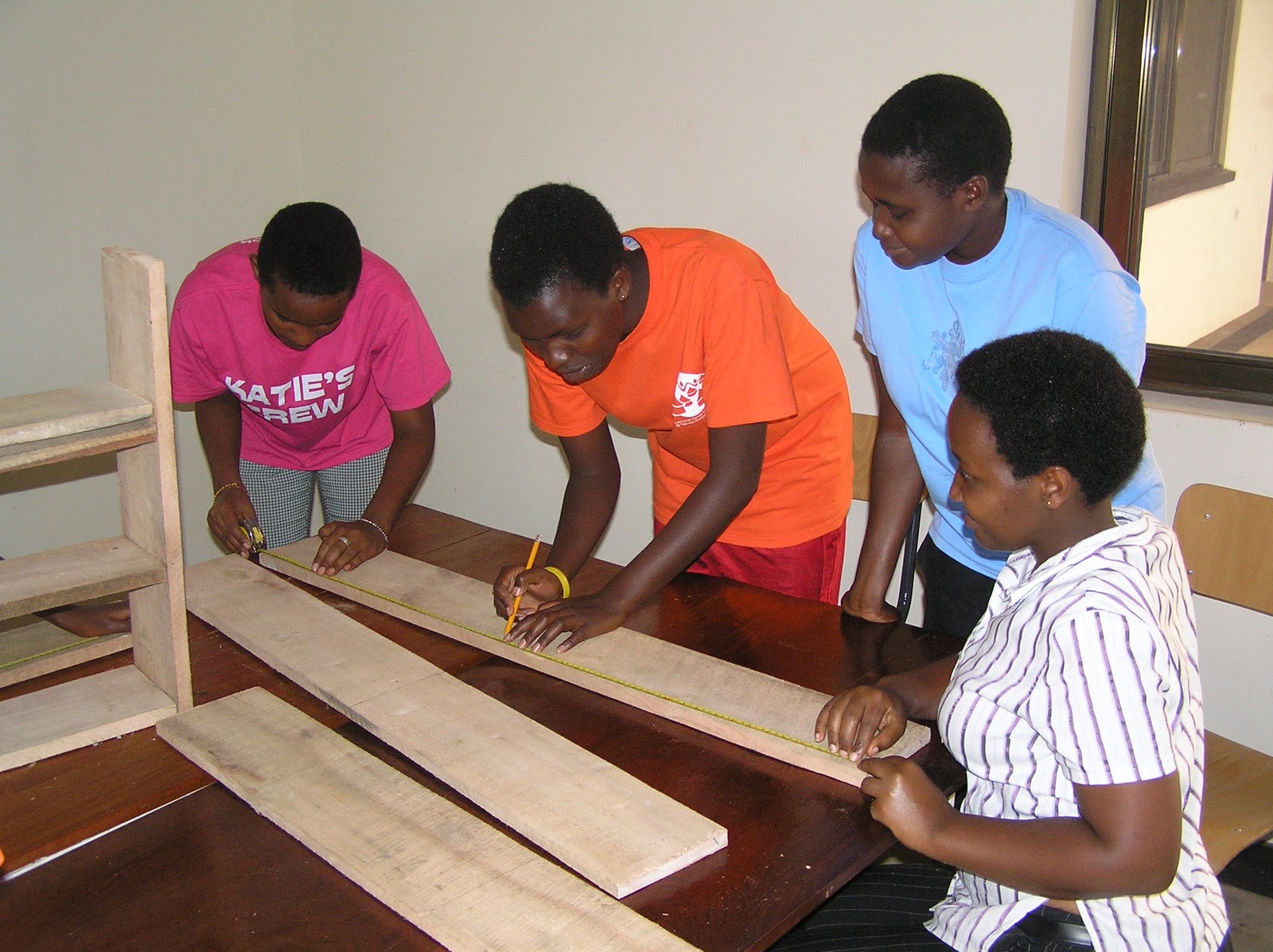
Students measure before they cut

At ASYV, outside of school, we have enrichment programs that seek to expose students to different fields and help them build skills. I teach the carpentry enrichment program for the equivalent of 9th and 10th grade students each Monday and Thursday.

Students work together to get their angles square

On the first day of my carpentry EP, I was waiting near the center of the village for my students to show up. I had no idea who was in my program, so I asked two boys who were heading over toward the shed and wood supply. They said they were not in carpentry, but as they came back from that area a few minutes later one boy told me, "Your students are over there, but there is a problem. They are all girls." It was a powerful way to start my EP because it made me realize that through carpentry I could offer my students- most of them female- more than just skills, but empowerment through building.

Our first set of tools rest on top of the first item that students built

We started with a partially-broken hammer, a box of nails, and a carpenter square from last year’s carpentry program; I added my small tree-limb saw, a 1.5 meter tape measure, and a pencil that I brought with me from the States. That first day, we covered the names of the tools and tool safety; each student got to practice using each tool. We built a small table that the students were quite proud of because they had not used most of the tools before the class.

Sawing at a 45 degree angle... nice form!

I took a bus to Kigali on the weekend and bought myself a nice collection of tools for my students to use. I bought 4 hammers, 4 hand saws, 4 carpenter squares, 4 tape measures, and several sheets of sandpaper. About a month later, we got a donation of tools from America that added wood rasps, several sizes of c-clamps, and safety goggles.

Enrichment year (9th grade) students with their finished shelf

In the past 6 weeks of carpentry, my 28 students have learned some of the basics of carpentry and have begun to apply their skills for village projects. Our first project was to build shoe shelves. We have built 9 shoe shelves for different houses. We built a projector stand for the computer lab. We are nearly finished with 4 benches and will build several more for use around the village. Upcoming projects include cabinets for the science center, shelves for the new computer labs, and tables for the canteen. By building items that the village needs, the students not only gain skills but get to see how their hard work benefits their community.

Enrichment year (9th grade) students pose with the projector
stand they built for the computer lab. 

My students are getting better each week at hammering, sawing, measuring, and ensuring their joints are square and flush. Some of them are even starting to design their own projects; perhaps they are future carpenters at work!


Before carpentry students built this shelf, the closet floor
was covered in shoes. It was a great first assignment
for beginners!

(PS: A shout-out to the people that helped me learn tool use over the years- I am happily passing it on to my students!)

Tuesday, January 11, 2011

Organic Agriculture and Composting in Rwanda

On Friday, I joined a small group from ASYV for a field trip to learn about organic agriculture in Rwanda. This group included a chemistry teacher, school administrative staff (myself), an informal education representative, two farm staff, and a landscape staff member. Our objective was to get some ideas on how to build environmentally sustainable practices into our operations and educational programs. We specifically wanted training on composting in the tropics and on plants that could be incorporated into our landscaping and farm to decrease pests without pesticides.
Entrance to the GOFTC demo farm

The training was at the Gako Organic Farming Training Center (GOFTC). The center opened in 2000 and has since trained over 60,000 farmers from Rwanda, Burundi, and the Democratic Republic of the Congo. Its founder and director, Richard Mynyerango, was our host for the day.

“No matter how big you are, a president, a businessman, or anyone, at the end of the day you still have to eat.” Richard said. The center is largely focused on just that: connecting people to the idea of healthy food and the how-to of growing it.

A terraced mound garden at GOFTC

While Richard and his center promote protecting the environment through organic agriculture, their approach is centered in helping people. Richard said they are looking for ways that organic farming and conservation can boost peoples’ income, open new cottage industries, and shift people from subsistence agriculture to accessing markets. With the environment as his guide, he is searching for “anything we can do to improve the livelihood of the people.”

Many of the innovations that the center promotes are not necessarily new to the world, but they are adapted to local conditions for use by local people. For example, space is very limited in Rwanda. Not only is it a small country, but it is very densely populated. If people do not have enough land, then they may not be able to produce enough food. Since 90% of Rwandans are farmers, this is a huge issue. The GOFTC promotes several space-optimization schemes to increase the amount of food grown in the same space. Two that really stuck out to me were the mound gardens and the sack gardens.

A mound garden can double the growing space

Mound gardens are soil (and compost) piled up in a small hill. The mound allows more plants to grow because it increases the surface area available for growing. The chemistry teacher with us calculated that it doubles the amount of growing space.  The sack garden is like a kitchen container garden on a larger scale. A durable sack is filled with soil and compost, staked with a post on 4 sides, and holes cut from bottom to top. Plants like onions were planted in the sides of the sack garden and herbs on top. Again, it is an increase in the surface area- and thus growing space- that is the real benefit of the sack container.

Sack gardens are used to optimize space

Other technologies they promote are rabbit, goat, or cow pens that allow for easier collection of manure and urine for use in composting or fertilization. They are also promoting dairy goats, but face a lot of resistance as there is a stigma about goat milk here in Rwanda. They experiment with different drainage systems and siltation traps to reduce erosion and catch topsoil that would otherwise be lost. They keep bees and remind people that if they use chemical pesticides on their farm, it will kill their bees. They experiment with mushroom production and with plants as-of-yet unused by most Rwandan farmers like bamboo. Perhaps most impressive to me is that these technologies are being tried by Rwandans for Rwandans; they are using materials that are accessible locally and are affordable for most people.

Rabbit hutch with easy manure collection (this hutch was
three containers high, again optimizing space)

One technology that has potential for renewable energy production in Rwanda is biogas. GOFTC has several underground tanks that allow for anaerobic (without oxygen) breakdown of its cow manure; they are able to use one of the end products of the breakdown, methane, to power their stoves (and hopefully some day, their other electricity too). Our lunch for the day was cooked on a biogas stove, and it was delicious! We ate most of the food, but I am guessing what was left over was composted.

Lunch being cooked on a biogas stove


GOFTC promotes composting as a way that Rwandans can improve their soil fertility. From my observation, composting in Rwanda is not that different than composting in the Midwest or Eastern United States (or perhaps elsewhere, but I have only composted in those two regions). Decomposition is the same process, with pretty much the same biological and chemical forces at work, and humans are just managing it to get a desired product. Climate does affect the composting process. There are two main seasons here, wet and dry, which essentially produce opposite problems: too much moisture getting into your compost or too much moisture loss from the pile. The compost book that GOFTC uses is a UK-based book (All About Compost by Pauline Pears) that has two basic pages on composting in the tropics. For the wet season, it recommends using large leaves to cover the compost to retain moisture. For the dry season, the book recommends again using large leaves for moisture retention or to bury the compost in a shallow pit.

Compost site with greens and browns waiting to be processed

GOFTC builds small structures over their compost to reduce moisture loss, protect from torrential rains, and keep their compost form baking in the equatorial sun. The compost cover has a post on each corner and a basic roof structure of attached sticks and large leaves draped over the sticks. As GOFTC does a lot of composting, these structures were fairly large and provided nice shade for us as we observed. The method of composting that GOFTC uses is called lasagna composting (called that in America, but I am not sure if they have names for different methods here), and it involves building your compost pile with specific layers. They start with sticks at the bottom to provide aeration and room for macro-invertebrates, then a 30 cm layer of dry brown materials, a thin layer of dry ash, a soaking of water or animal urine, a 30 cm layer of dung, a layer of topsoil, a 30 cm layer of freshly dead green materials, dry ash, and then start over adding another dry brown layer. Richard presented a reason for each layer, such as for instance, using ash to add potassium. He recommended checking the compost every 3 days and then after 14 days turning it. Most of these “waste” materials are available on a Rwandan farm, and while they will break down anyway, composting them in a managed way can provide the farmer with quick and high-quality humus that improves their soils’ productivity. Richard said they get finished compost in about 4 weeks.

Smaller compost site at the demo farm
also has a pit for materials storage

I got the impression from Richard that organic agriculture is still in its infancy here in Rwanda, but it has serious room for growth. One major challenge is that most people here cannot afford the higher prices of organic food. Organic food commands premium prices, but these are mostly from external markets, not local ones. Encouragingly, he said that the perception of the organic approach has changed in the last ten years from discouraged and un-modern to viable; he said even some agencies are beginning to promote it. Richard said, “no longer do the organic farmers walk with shoulders down. They now hold their shoulders high.” For the sake of the butterflies, birds, and the people of Rwanda, I hope that organic agriculture continues to grow and improve the lives that it touches.

Digging in!


Sunday, December 26, 2010

Meeting some of the world’s poorest, but nicest, people

12/19/2010

I slept in today for the first time in several weeks. When Michele got back from leading a yoga session, she told me we had been invited to visit a Batwa village.

The Batwa are one of the ethnic groups here in Rwanda. They were pygmy hunter and gatherers settled here long ago, but adapted as the forests were cleared and other groups settled. Over the last couple centuries there has been much mixing of ethnic groups here so now the term “Twa” (short for Batwa) is generally used to describe very poor people.

Twa people singing and clapping

Our two hosts for the field trip met us at our village. One works here from America on official business and the other is a Rwandan social entrepreneur who does many things, but is currently involved in helping spread technology through Rwandan schools. Both of these individuals had helped this Twa village over the last couple years to improve their situation.

When our hosts first got involved, the village was extremely poor and was seriously impacted by malnutrition. For example, they ate no more than one meal a day. They did not have sewage treatment or even pit latrines, so their waste was a direct hazard to their water supply.

Over the last couple years, with outside help, they have acquired a few cattle, a few goats, rabbits, and improved their wastewater situation. They also have built two water catchment systems (think big rain barrels) that collect water from the two metal roofs they have, which reduces the trips down the hill to a small stream. They now get to eat twice a day, but are still food insecure (if disaster, drought, or if disease hits, their health will decline rapidly and they will starve).

View from the Twa village

One-hundred and sixty-eight people lived in this village, on the side of a hill outside of Kigali (the capital). Their view was beautiful, looking down over a green valley eventually climbing up into hills. The first striking thing, however, was not the poverty, but the overwhelming warmth with which we were greeted. So many people came up and hugged each of us.  Men, women, and children all came up to hug and shake our hands as if we were old friends or family. It was almost overwhelming, but I felt like I was very welcome on their land.

A Twa family's circular hut

We toured the village and got to step inside a few “houses.” This settlement had no electricity or running water. The first home we visited was constructed of wooden limbs tied together and walled with red clay and pebbles. Its roof was thatched plant material.  While these roofs are traditional Rwandan, they can be problematic when it rains. Only two homes in the village had corrugated metal roofs, which keep water out. These metal-roofed homes had the water catchment systems. Just across from the more modern hut with the metal roof was a circular hut with a thatched roof. A mother and father lived in this hut, which contained a raised cot and shelf hand-made of local materials. It also contained several pots on top of an open fireplace (really just a place for a fire on the floor).There was only room for three of us to stand huddled together, and we were nearly spilling out the entrance. Other homes were even smaller, with some like tents made of thatched plant material and some made of clay. Families live in these tiny spaces… And I thought my 315 square foot apartment in NYC was on the smaller side.

A Twa family's residence

Once back in the common area, the inhabitants broke into song and dance. It was like a flash mob, without any clear direction or leader. From the video we got, I can count at least 41 people of all ages involved.  The mix of clapping, drumming, and singing lasted around six minutes. Afterward, some villagers spoke in Kinyarwandan and a translator explained to us that they were so grateful for us to come and see their performance.

Twa dancing

The young Rwandan social entrepreneur then handled details of some microloans with the villagers. People expressed their concerns, asked questions, and divided up the funds. They will be trying three small new businesses that should bring desperately needed income. Currently, other than subsistence farming, this village has one source of income. They carve sharp sticks for brochettes, roasted lamb meat on a skewer, which is a popular treat in Rwanda. For 100 skewers, they get 100 Rwandan francs, which is about 17 cents US dollars. I counted at least two piles of 600 sticks made by many people, and I am not sure how many they make over all.  But consider the math: if they produced 10,000 skewers a day, then that would bring in about $17 USD. Divided by 168 people, that is just about a dime a day per capita income. And I doubt they produce or could sell that many skewers on a regular basis. Such small amounts, such as a $100 microloan, can make tremendous impacts on the lives of those who need it most; they are often are willing to work very hard to improve their lot when given the opportunity.

Both men and women carve the brochette skewers

Poverty comes in many forms and can be defined in many ways, but generally, according to the World Bank, poverty is “pronounced deprivation in well-being.” The people I met today have very little income, produce most of the food they eat, and have no refrigeration to prevent spoilage. They do not have access to modern health care, do not have running water or electricity, and do not have vehicles or other personal transportation. The road to their village is narrow, unpaved, and marked with deep gullies from erosion. Some of these challenges can be resolved fairly easily, while other improvements may take decades of societal change to produce.

600 brochette skewers will sell for just over $1 USD

As we left the Twa village, I reflected on how positive they seemed to be despite the tremendous challenges they face. They have so little, but they work hard. They band together to share when it would be easy to fight for small bits. I hope that their situation improves and that as it does, they keep the sense of community that they possess. My visit with some of the world’s poorest people was quite a humbling experience.