Friday, May 27, 2011

Flamingos, ostriches, and other big birds of East Africa

Big birds capture the imagination, amaze the eye, and sometimes appear to defy physics. Even non-birders tend to be impressed by the big, especially brightly-colored birds. They are featured in literature (think Alice in Wonderland), in art (cranes in Asian art especially), and in urban legend/mythology (storks bringing newborns, owls having wisdom, etc.). Zoos often feature these birds not only because they can be easily seen by visitors but for conservation reasons. 

Big birds are easily found and hunted in the wild and are often heavily impacted by habitat alteration. Some birds, such as the lappet-faced vulture, the southern ground hornbill, and the ostrich, have suffered heavily declines due to hunting by humans. Other birds, such as the grey-crowned crane, are celebrated (national bird of Uganda) and kept as domestic pets; habitat loss and capture from the wild has subsequently decreased wild populations by up to 50%. Big birds are important contributors to their ecosystems and inspiration to many cultures; hopefully, they will remain visible in the wild in East Africa and on Planet Earth.


Although the greater flamingo is much bigger, the lesser flamingo, Phoenicopterus minor, is a  big, goofy, pink bird with a very interesting bill. We counted nearly 3000 individuals at Arusha National Park in Tanzania.


The common ostrich, Struthio camelus,  has a mass ranging from 90 to 130 kg (up to  286 lb) and stands tall at 2 meters.  Ostriches eat mostly plants and require up to 3.5 kg of food a day. They are the largest living birds on Planet Earth, although larger birds of Madagascar and New Zealand went extinct in very recent times due to hunting (in the last few hundred years). The ostrich itself has been extirpated from Southwest Asia, the Arabian peninsula, and Northern Africa. Pictured in Tarangire National Park, Tanzania.


The lappet-faced vulture, Torgos tracheliotis, is tied for the largest vulture in Africa. This species' wingspan can beat 2.8 meters; imagine its wingtips touching the ground and nearly reaching the rim of a basketball goal. While it is mainly a scavenger, this species can hunt live prey like flamingos! It has suffered heavy declines to due accidental (when it eats poisoned carcasses of carnivores) and deliberate poisoning. Pictured in Tarangire National Park, Tanzania.


Kori bustards, Ardeotis kori, are the heaviest flying birds in Africa; males can weigh up to 19 kg (over 40 lb). Although I have never heard the Kori bustard in the wild, it once captivated me at a younger age with its strange "vooomp"  boast at the Kansas City Zoo and consequently was at the top of my "have-to-see" list. Seeing them in the wild, pictured above in the Serengeti plains, is one of my favorite memories of birding in Africa so far.


The secretarybird, Sagittarius serpentarius, is a unique bird of prey that stalks arthropods, small mammals, and reptiles by looking for movement and then striking or chasing after them. While its wingspan ranges from 1.2 to 1.35 meters, giving it much longer wings than martial eagles and Kori bustards, it is only about half the wingspan of the lappet-faced vulture. Picture in Serengeti National Park, Tanzania.


Depending on age, genetics, and other factors, the martial eagle, Polemaetus bellicosus, competes with African crowned eagles and Verreaux's Eagles for the title of Africa's largest eagle. Although it generally sticks to smaller prey like hares, wild cats, hyraxes, and chicken-sized birds, martial eagles can and do successfully hunt monkeys, baboons, and even small antelope. Picture from Tarangire National Park, Tanzania.


The goliath heron, Ardea goliath, is the largest of all living herons.  Its wingspan on average is 2 meters, and it prefers to eat big fish (fish measuring, on average, 30 centimeters, longer than my forearm). Although the patterns cannot be seen in this picture, note its thick bill. For a while, blacksmith and crowned lapwings roamed next to the bird, underscoring how large this individual was. Seen in Serengeti National Park, Tanzania.


The southern ground hornbill is one of two species of ground hornbill, both found in Africa. Bucorvus leadbeateri is very large, and although it does fly, it spends most of its time walking around snatching arthropods and reptiles from the ground. We have seen only two, both at Lake Manyara. This bird is a female, determined by the presence of blue on the neck under the bill (not visible in the picture).


Verreaux's Eagle-Owl is small compared to the other birds on this post, but it is sub-Saharan Africa's largest owl; only two other owls get close. This species, Bubo lacteus, was seen awake at Tarangire National Park in Tanzania just before sunset. 


This page does a poor job of showing the storks of East Africa. I have seen black storks, white storks, yellow-billed storks, and African open-billed storks, all of which are big birds. Marabou storks, however, can get to be the largest of them all. The marabou stork, Leptoptilos crumeniferus, is also probably the least attractive of the storks, though beauty is in the eye of the beholder. Picture at Akagera National Park, Rwanda.


Grey crowned cranes, Balearica regulorum, can be found in East and Southern Africa. These individuals were seen in Lake Manyara National Park, in Tanzania, but I have seen them several times in Rwanda as well. Despite having wingspans up to 2 meters and standing around a meter high, they only weigh 3 to 4 kilograms (about 7-8 lb). 

Other birds that belong on this page that I have seen but do not have pictures are the great white pelican and the pink-backed pelican. Birds that belong here that I have not yet seen are the saddle-billed stork, Denham's bustard, and the shoebill. Also, I could include a number of herons, perhaps the sacred ibis, the white-backed vulture, and Rueppell's griffon vulture. Another day...

Works Cited

  • Anderson, M. 2008. Lappet-faced vulture” (On-line), ARKive: Images of Life on Earth. Accessed May 26, 2011. http://www.arkive.org/lappet-faced-vulture/torgos-tracheliotos/#text=Biology
  • Bible, J. and T. Root. 2007. "Ardeotis kori" (On-line), Animal Diversity Web. Accessed May 26, 2011 http://animaldiversity.ummz.umich.edu/site/accounts/information/Ardeotis_kori.html.
  • BirdLife International (2011) Species factsheet: Balearica regulorum. Downloaded from http://www.birdlife.org on 27/05/2011. Recommended citation for factsheets for more than one species: BirdLife International (2011) IUCN Red List for birds. Downloaded fromhttp://www.birdlife.org on 27/05/2011.
  • Donegan, K. 2002. "Struthio camelus" (On-line), Animal Diversity Web. Accessed May 26, 2011 http://animaldiversity.ummz.umich.edu/site/accounts/information/Struthio_camelus.html.
  • Fanshawe, J. and Stevenson, T. Birds of East Africa. Princeton and Oxford: Princeton University Press, 2002. 
  • Krause, B. and P. Rasmussen. 2009. "Bucorvus abyssinicus" (On-line), Animal Diversity Web. Accessed May 27, 2011 http://animaldiversity.ummz.umich.edu/site/accounts/information/Bucorvus_abyssinicus.html.
  • Overholt, W. 2011. "Polemaetus bellicosus" (On-line), Animal Diversity Web. Accessed May 26, 2011 at http://animaldiversity.ummz.umich.edu/site/accounts/information/Polemaetus_bellicosus.html.
  • Ryan, P. and Sinclair, I. Birds of Africa south of the Sahara. Struik Nature: Cape Town, 2003.
  • Shirley, E. 2011. "Ardea goliath" (On-line), Animal Diversity Web. Accessed May 26, 2011 at http://animaldiversity.ummz.umich.edu/site/accounts/information/Ardea_goliath.html.
  • Sherman, P. and P. Rasmussen. 2007. "Sagittarius serpentarius" (On-line), Animal Diversity Web. Accessed May 26, 2011 http://animaldiversity.ummz.umich.edu/site/accounts/information/Sagittarius_serpentarius.html.
  • Thairu, M. 2011. "Balearica regulorum" (On-line), Animal Diversity Web. Accessed May 27, 2011 at http://animaldiversity.ummz.umich.edu/site/accounts/information/Balearica_regulorum.html.

Saturday, May 14, 2011

The rarest bird I've ever seen

Sometimes you just get lucky. That’s how I saw the long-billed tailorbird. As indistinct as it looks, I remember the exact moment the long-billed tailorbird became visible in a tangle of vines just a few meters above my head. I remember only catching its face briefly, but seeing its body much more clearly. There wasn’t much to see more than a small greyish upper-body, paler underside, and legs. It worked along the vines, disappearing for a few moments and then reappearing briefly. And then it was gone.

Water rushes over rocks in this stream in Amani Nature Reserve,
providing a great soundtrack to a search for birds.

The long-billed tailorbird is only found on two places on planet earth, in and around the Amani rainforest in the East Usambaras and in an area in Northern Mozambique; the two populations are separated by 1000 km. Birdlife International lists this species as critically endangered with only up to 249 mature adult birds in the wild. Birdlife’s justification for this status, in addition to its small population and range, reads that, “Given that much of its habitat is being altered rapidly and is becoming increasingly fragmented, the species is likely to be undergoing a continuing decline, at least in some parts of its global range.” This is one of those birds you probably won’t hear about as it is not spectacular looking, but you may see its name grace a recently-extinct list in years to come.

Forests all over the world are being cut. The drive to the Amani rain forest
goes past several sawmills. Here the clearing goes right up to the
edge of the Amani Nature Reserve. 

Michele and I happened to be lucky enough to witness this bird for a few reasons. We were in its habitat, birding the Amani Nature Reserve in the East Usambara Mountains of coastal Tanzania. Hiking through this forest on trails, sometimes in the rain, did not provide easy views of birds. As with many of the birds we saw at Amani, this bird was our guide’s find entirely, who is the other main reason we saw this bird. Our guide, Martin, actually does research on the very bird, Artisronis moreaui. We were birding on this guy’s home turf.

Look, it's a bird! Our guide, Martin, on the right, was a very sharp birder.
This was not the moment of the tailorbird, but taken shortly before.


We were ascending the peak of a mountain (really low as far as mountains go: the peak was 1050 meters above sea level while Mt Kilimanjaro is 5,985 meters above sea level) and trying not to slip in the mud when all of the sudden, Martin says, “I hear it. He’s here.” Our guide was a pretty chill guy, but here he started to appear excited. At this point it really hadn’t dawned on me that I was about to see the rarest bird I have ever seen. As the bird calls again, I ask, “What are we hearing?” Martin replies, “The long-billed tailorbird.”


To capture a picture of this bird would have required a lot more time,
audio recordings, and a serious camera (not my point-and-shoot).
I am
relying heavily on my three field guides and the picture on Birdlife
International to draw this bird, but I did draw it free hand and tried to make
it my own (not simply copying the posture and impression that others did,
although this is not the posture as I saw it- it was much more horizontal
creeping along the vines). I am just getting into drawing and painting,
mainly because it is helping  focus on the details and topography of birds.
This is just my third piece- the real challenge will be drawing birds
in the field, not based on still images.

The bird is in the tangles on a tree to our right, then directly in front of us, above us and above the path. It was then that we saw it. Again, this is not a spectacular looking bird. As far as personality goes, it really didn’t stand out in my mind as great either. It was there gleaning insects, I suppose, and then it was gone. But what is crazy about this bird, is that out of the 2000+ species in Africa, there is only one other bird in its genus (the Eastern Arc Mountains endemic African tailorbird, which we saw numerous times in the West Usambaras) (Remember, genus is the level of classification above species, Domain-Kingdom-Phylum-Class-Order-Family-Genus-Species). The bird is thought to be more closely related to Asian tailorbirds than anything else in Africa. And again, with an estimated 50-249 mature individual birds in a very restricted range, this bird is very rare. Most people who have seen it get it with playback, which involves first recording the bird and then replaying its sounds to elicit a response and perhaps a clear showing. We did not use playback, which is a good way to miss a bird usually, but because of our particular location at that moment, the bird’s particular location at the moment, and the expertise of our guide, our paths collided.

Jared and Michele at the top of the 1050 meter mountain, post-tailorbird.
In the back is rainforest, with a clearing on the right (tea cultivation).
Photo by Martin, our guide.

We saw some great rare and endemic birds while traveling around Tanzania. There were dozens of other birds I was more excited to see beforehand, but this one surprised me. It was a gift of luck, a flash of feathers, and a glimpse of the great biodiversity filling the pockets of the planet.  And up to this point in my life, it is the rarest bird I have ever seen.

Works Cited

  • BirdLife International (2011) Species factsheet: Artisornis moreaui. Downloaded from http://www.birdlife.org on 14/05/2011.
  • Fanshawe, J. and Stevenson, T. Birds of East Africa. Princeton and Oxford: Princeton University Press, 2002.
  • Pearson, D.J., Turner, A.T. and Zimmerman, D.A. Birds of Kenya & Northern Tanzania. Christopher Helm: London, 1999.
  • Ryan, P. and Sinclair, I. Birds of Africa south of the Sahara. Struik Nature: Cape Town, 2003.

Saturday, May 7, 2011

Happy Mother's Day (and baby animals)!!!


Michele and I recently visited Tanzania to look for birds and other wildlife. Many big mammals of East Africa breed and then give birth to their young to coincide with the rainy seasons (November-May), which provide the most grazing (and hunting!). At this time of year, when grasses are high, trees are covered in leaves, and food abounds, wild babes have stronger chances at survival. Most of these photos also highlight the adults, usually the mothers and female groups, that help raise them to adulthood.


A lioness (Panthera leo) with her two cubs trek along the Tarangire River bed in Tarangire National Park. Cubs can run by the time they are one month old but depend on their mother until about 16 months old.


A baby African bush elephant (Loxodonta africana) stays close to its mother in Tarangire National Park. African elephants have a gestation period of nearly two years (about 21 months) before the baby is born. On average, the elephant young breast feeds for about 78 months. Happy Mother's Day indeed!


African buffalo females (Syncerus caffer) from strong bonds with their young. The young females remain with their mothers until they reproduce on their own (five years to sexual maturity). Young males join other male groups after two years. (Arusha National Park)


Giraffes (Giraffa camelopardalis) actually breed in the rainy season and have their young in the dry season. However, this young giraffe will stay with its mother for about 14 months. (Arusha National Park)


A young olive baboon (Papio anubis) hitches a ride on an adult's back, possibly the mother's, judging from the size and apparent lack of a facial mane. Males also carry the young although the mothers do most of the rearing. Baboons, can live in large groups with many males, females, and young; these two baboons were photographed in a group with more than 45 individuals in Arusha National Park.
Happy Mother's Day!

Works cited:

  • Harrington, E. and P. Myers. 2004. "Panthera leo" (On-line), Animal Diversity Web. Accessed May 07, 2011 http://animaldiversity.ummz.umich.edu/site/accounts/information/Panthera_leo.html. 
  • Kingdon, Jonathan. The Kingdon Pocket Guide to African Mammals. Princeton and Oxford: Princeton University Press, 2004. 
  • Maisano, S. and A. Fraser. 2006. "Giraffa camelopardalis" (On-line), Animal Diversity Web. Accessed May 07, 2011 http://animaldiversity.ummz.umich.edu/site/accounts/information/Giraffa_camelopardalis.html. 
  • Newell, T. 2000. "Syncerus caffer" (On-line), Animal Diversity Web. Accessed May 07, 2011 http://animaldiversity.ummz.umich.edu/site/accounts/information/Syncerus_caffer.html. 
  • Norwood, L. 2002. "Loxodonta africana" (On-line), Animal Diversity Web. Accessed May 07, 2011 http://animaldiversity.ummz.umich.edu/site/accounts/information/Loxodonta_africana.html. 
  • Shefferly, N. 2004. "Papio anubis" (On-line), Animal Diversity Web. Accessed May 07, 2011 http://animaldiversity.ummz.umich.edu/site/accounts/information/Papio_anubis.html.

Friday, April 15, 2011

Berlin: JSC Midyear Conference

Painting of Israeli and German flags on Berlin Wall


Michele and I had the opportunity to attend the Jewish Service Corps Midyear Training Seminar in Berlin this past week. It was great to be able to step away from our work and placement sites to reflect from afar. It was also amazing to meet with around twenty-five other people who have different placement sites around the world. Besides Rwanda, the fellows are working in Argentina, India, Russia, Germany, Ukraine, Serbia, Turkey, Estonia, Poland, and Israel.

JSC fellows explore Berlin. Here we examine a monument
dedicated to to people who fled or were taken
 from their homes during WWII and the Holocaust.


As much as I enjoyed the delights of the Western developed world, like cheese, apples, and hot water, I will miss the people the most. I did not know any of the other JSC fellows before, but the bonds formed quickly due to shared purpose and similar challenges. It struck me at the end of the conference that it was probably the only time that this particular group would be in the same room together. It is sad to think that this gathering was a once-in-a-lifetime occurrence, but it was the highlight of my trip to be part of an exciting interaction among young, motivated, and passionate people.

A painting on the Berlin Wall depicting a man
climbing over the Berlin Wall. 

In our closing session, we were given fifteen minutes or so to create something that reflects on our work and the conference. I wrote these two acrostic poems:

“Rwanda”
Rice, beans, and bananas
Walk everywhere
Amahoro (peace, in Kinyarwandan)
Never again (all genocides must stop)
Day by day living
Agahozo (a place where tears are dried, in Kinyarwandan)

“Berlin”
Berlin has brought
Everyone together from
Round the world where we are
Learning from each other about
Impacts we probably can’t yet see but
Nevertheless are making.

Thursday, March 31, 2011

ASYV: Over 100 species and counting!


Agahozo-Shalom Youth Village is a good place to watch birds. Several visitors from the United States and Israel and about 20 of the Rwandan students have participated in bird walks so far. There are many birds to see, and part of my job is to keep track of them. 


Students at ASYV are using binoculars and
thinking critically about how to find and identify birds.

I have surveyed birds here from about 6am-8am on average about four days a week since early December, totaling just over 149 hours on 69 days. Although I love bird watching, it is not all fun and games. Surveying involves getting up regularly at 5:30 am before sunrise, getting bitten by ants at least once a week, soaking my shoes/sandals each day while walking through the thick morning dew, meticulously taking notes, and lugging a camera or computer around for documentation. I also have to transform my notes into electronic form.  Data entry is absolutely necessary for keeping an inventory, but it is the most boring part of the job.


The amazing Ross's Turaco! You can see the bright
yellow face and bill and the red mohawk well. You can
sort of see the bright blue/purplish color its body. What
you cannot see is the bright red patches on its wings,
only visible when in flight. I have seen this species 
(Musophaga rossae) at ASYV 6 times, only in the 
undeveloped area behind the school. 


So far, I have identified 115 species of birds that live on or have visited the 144 acres of ASYV property, with another 6 birds narrowed down but not to the species level. To put this in perspective, around 17% of the birds found in Rwanda or about 1% of the world’s birds can be seen right here in this small space.


The African yellow white-eye, Zosterops senegalensis, is a
delightful little bird.

About 87% of the 115 birds have been spotted at least twice; only 15 birds have only a single record. For example, I have found the violet-backed starling only once (although there were four individuals present that day, 1 male and 3 females). In contrast, I have seen the very-easy-to-see pin-tailed whydah on all 69 days.

A male violet-backed starling, Cinnyricinclus leucogaster,
was quite an exciting find!


Birds from 36 families have visited or live at ASYV (add to that families of two birds as-of-yet unidentified, woodpeckers and nightjars). Remember, a family is a grouping of organisms in the Domain-Kingdom-Phylum-Class-Order-Family-Genus-Species taxonomic system. Among the families (which are in parentheses), there have been six species of sunbirds (Nectariniidae), 7 species of dove/pigeon (Columbidae), 9 species of martins/swallow (Hirundinidae), 10 species of waxbill (Estrildidae), 11 species of Accipitridae birds of prey (not including the two birds of prey from Falconidae), and 11 species of weavers (Ploceidae). 


This male scarlet-chested sunbirdNectarinia
senegalensis
, is as pretty as they get. The turquoise
on the head is not always seen and this is the only
photograph I have that captures the head color.
Visiting ASYV? You have a good chance of seeing it,
as I have recorded it more than 1 out of every 2 days.

Six species remain elusive: a woodpecker has been spotted twice, a swift that defies my dichotomous key, a female cuckoo that has only been around once, an Aquila species of eagle, a black-faced bird of prey, and a nightjar. Most of these birds have been visible for just a short glimpse, or I have yet to see the details I need to make an identification. I have also heard of an owl that people have seen, but it has not been reported in months and I have yet to see any trace of it. 


The spot-flanked barbet, Tricholaema lacrymosa, is one
of two species of barbets I have found at ASYV.
Neither species is common on the property; I have only
three records for this species.


Is all this information for the birds? Of course not. It is important for several reasons. First, it serves as a pool of data for student use. The sciences and mathematics are major fields in Rwanda; the analysis and the process of gathering the data provides students with hands-on experiences. It also allows students to learn the techniques and methods of finding and identifying birds. For future park rangers, tour guides, and biologists, they can gain skills they need to be competitive for good jobs. Second, it gives ASYV an important tool for attracting tourists. Rwanda has a lot of potential as a birding destination and having an established bird list (plus a lodge and proximity to Akagera National Park) will capture the attention of birders and tour operators. Third, it allows the students, staff, and visitors to appreciate the natural capital present at ASYV. Although many rural people here have a recognition of some of the birds, they have yet to see many of the wonders up close or understand their full ecological roles (this is based on my conversations and observations). Furthermore, people from the city who now live at ASYV have little recognition of the birds at all or their importance (much like America and probably everywhere else).


Cinnamon-chested bee-eatersMerops oreobates
live at ASYV and are a pretty regular bird
 in the undeveloped area behind the school. 
Yes, they do eat bees, and they catch them 
spectacularly while in flight.


In the coming months, I will devote posts to the most common birds, most unusual birds, the breeding birds, and peoples’ interaction with our feathered friends. In the meantime, I hope you enjoyed pictures of some of my favorite birds at Agahozo.

Saturday, March 12, 2011

Building the Future

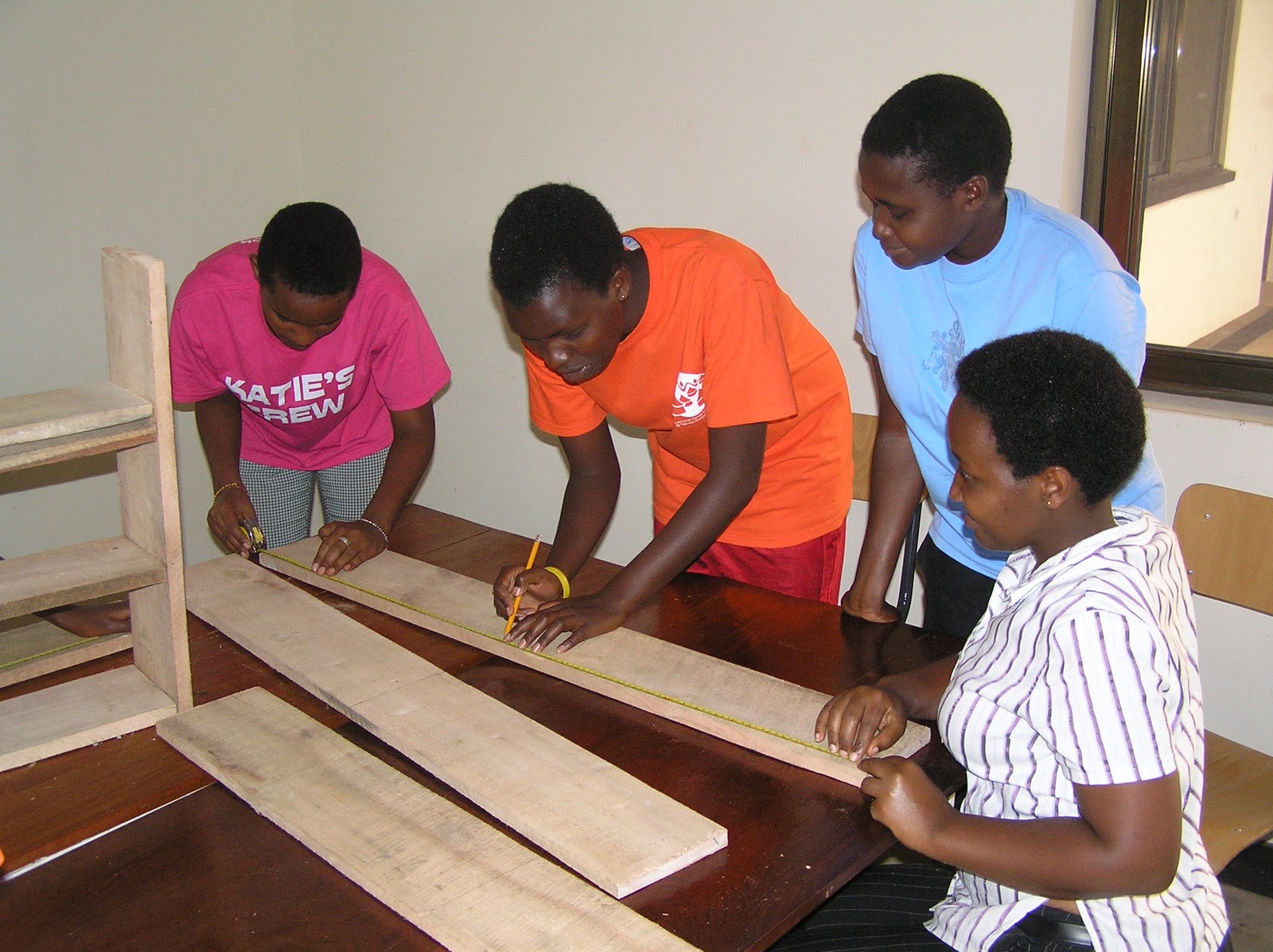
One of the important tasks we have at Agahozo-Shalom Youth Village is preparing our students for life after high school. Some students will go to university while others will enter the workforce. In a country with many people and fewer jobs, skills are of utmost importance.

Two senior four (10th grade) students finish building shelves

Students entering the workforce without specialized skills may have to settle for a job with lower income. For example, in the construction industry, the lowest rung of employment is the porter. Porters make around 1000 RWF per day (about USD $1.68). A porter may do any number of things such as cut wood or haul stones; it is extremely hard work. A carpenter, however, may make 2500 RWF per day (about USD $4.20). Clearly, having specialized skills is an advantage to our students.

Students measure before they cut

At ASYV, outside of school, we have enrichment programs that seek to expose students to different fields and help them build skills. I teach the carpentry enrichment program for the equivalent of 9th and 10th grade students each Monday and Thursday.

Students work together to get their angles square

On the first day of my carpentry EP, I was waiting near the center of the village for my students to show up. I had no idea who was in my program, so I asked two boys who were heading over toward the shed and wood supply. They said they were not in carpentry, but as they came back from that area a few minutes later one boy told me, "Your students are over there, but there is a problem. They are all girls." It was a powerful way to start my EP because it made me realize that through carpentry I could offer my students- most of them female- more than just skills, but empowerment through building.

Our first set of tools rest on top of the first item that students built

We started with a partially-broken hammer, a box of nails, and a carpenter square from last year’s carpentry program; I added my small tree-limb saw, a 1.5 meter tape measure, and a pencil that I brought with me from the States. That first day, we covered the names of the tools and tool safety; each student got to practice using each tool. We built a small table that the students were quite proud of because they had not used most of the tools before the class.

Sawing at a 45 degree angle... nice form!

I took a bus to Kigali on the weekend and bought myself a nice collection of tools for my students to use. I bought 4 hammers, 4 hand saws, 4 carpenter squares, 4 tape measures, and several sheets of sandpaper. About a month later, we got a donation of tools from America that added wood rasps, several sizes of c-clamps, and safety goggles.

Enrichment year (9th grade) students with their finished shelf

In the past 6 weeks of carpentry, my 28 students have learned some of the basics of carpentry and have begun to apply their skills for village projects. Our first project was to build shoe shelves. We have built 9 shoe shelves for different houses. We built a projector stand for the computer lab. We are nearly finished with 4 benches and will build several more for use around the village. Upcoming projects include cabinets for the science center, shelves for the new computer labs, and tables for the canteen. By building items that the village needs, the students not only gain skills but get to see how their hard work benefits their community.

Enrichment year (9th grade) students pose with the projector
stand they built for the computer lab. 

My students are getting better each week at hammering, sawing, measuring, and ensuring their joints are square and flush. Some of them are even starting to design their own projects; perhaps they are future carpenters at work!


Before carpentry students built this shelf, the closet floor
was covered in shoes. It was a great first assignment
for beginners!

(PS: A shout-out to the people that helped me learn tool use over the years- I am happily passing it on to my students!)

Friday, February 25, 2011

Safari at Akagera National Park, second visit

A visiting teacher to Agahozo from New York was interested in a safari and told me she was a “wannabe birdwatcher.” I jumped at the idea… let’s split the cost and go birdwatching at Akagera National Park!

A vervet monkey on the move! (Cercopithecus aethiops pygerythrus)

Our driver was an hour late to pick us up this past Sunday, but it did not matter much as it rained from around 6:30am to 10am. Dark grey clouds loomed in all directions, and it did not look like a promising day for birds or any sort of fun.

Hippos (Hippopotamus amphibius) are easy to see at Akagera

We got to the outskirts of the park around 8am in our 4x4 jeep. The road up to the park entrance goes through some rather flat woodland. From what we saw in the rain, I estimate that it would be some excellent birding on a sunny day. There were of course common birds like grey-headed sparrows, red-eyed doves, red-cheeked cordon-bleus, ring-necked doves, black-lored babblers, and white-browed robin-chats. We also picked up white-headed black chats, grey-backed fiscals, Ruppell’s long-tailed starlings, European bee-eaters, greater blue-eared starlings, and lilac-breasted rollers, which are all pretty nice looking birds. We were treated to some helmeted guineafowl along the side of the road, and three African grey hornbills rested all wet from the rain in a tree. We drove up a hill to reach the gate, as the rain still fell.

Helmeted Guineafowl (Numida meleagris)

At the entrance gate, we stopped at the welcome desk. We filled out a form, met our park ranger, and paid our $30/person entrance fee. As we were walking out the door, the receptionist noted that we were birding and that the fee would actually be $70/person. I could not find any extra services we would be offered for the higher fee so I informed her that we would not look at birds and would just stick with the $30 “game drive.” The guides are pretty good with their birds, but of the two I have had at Akagera, they do not always know the birds at the species level (bee-eaters are bee-eaters, starlings are starlings, etc.). Plus, birds are the easiest group of wildlife to see. If they expect to get a premium price from birders, they better up the services, because I can bird just as successfully for $30 as I can for $70.

Giraffe (Giraffa camelopardalis tippelskirchi)

With our guide, we backtracked slightly to take the giraffe viewing road. We spotted one giraffe in the woodland, but the rain still poured. We picked up a neat mammal, a small antelope called a bush duiker, along the way. The only new birds we added were sooty chats and a lonely Senegal lapwing.

Olive baboon (Papio anubis)

The end of the giraffe road is back at the entrance gate, and I had our driver take us up to the Akagera Safari Lodge. I stopped in at the desk to get their most up-to-date contact information, as the Bradt guide and all the internet sources I have found were not current. Two olive baboons did show some interest in our car but quickly wandered off. We went to the lodge to look for the red-faced barbets that supposedly nests in a dead branch of a tree in the parking lot (I have seen in two sources, so I thought it was worth checking out). We found the ficus tree near the entrance to the parking lot that supposedly hosts the barbets, but the only dead branch had broken off and lay on the ground. We did get out and look around in the light rain, but did not find the barbets, which is a species endemic (found only) to the area west of Lake Victoria and in between the mountains separating Uganda/Rwanda/Burundi from the Democratic Republic of the Congo. I had hoped to see this bird, but we missed it here and on the day overall.

Hildebrandt's Francolins (Francolinus hildebrandti)

As we descended a giant hill toward Lake Ihema (the biggest lake at Akagera), we saw two fairly large antelope, waterbucks,  foraging in the grass. We found hildebrandt’s francolins, emerald-spotted wood doves, white-browed coucals, and a soaring African fish eagle. As we reached the edge of the lake, a few vervet monkeys captured our attention; they are very cute, a mostly grey-furred monkey, with a black face surrounded by white. A woodland kingfisher, Egyptian geese, African open-billed storks, and squacco herons populated the banks and nearby vegetation. A lone hippopotamus swam in the waters offshore. And then, some stunning blue-cheeked bee-eaters landed in a bush not far away! These, according to the African Bird Club list for Rwanda and the Birds of East Africa, are migrants and do not breed in Rwanda. They were very pretty, and the rain was finally stopping enough for me to take a few pictures through my spotting scope.

Blue-cheeked Bee-Eaters (Merops persicus)

We continued along the lakeshore, picking up African jacana, marabou storks, spur-winged lapwings, and long-toed lapwings along the way. We drove past a fishing village and through some woodland to another much smaller lake called Shakani. Here we saw a great white egret (same as great egret In Americas but here it is a different subspecies), numerous cattle egrets (many in breeding plumage), one intermediate egret, two little egrets, glossy ibis (same species as in Americas), hadada ibis, some great cormorants, and a grey heron. We had one sandpiper, but we had a poor view and did not bother to identify it at the species level. The highlight of this lake was a single yellow-billed stork, which we had previously only seen from afar; this bird was close, and modeled for our cameras. A single Nile crocodile swam across the lake, showing just enough to be seen- if you are looking- but it posed a certain danger to any unsuspecting bird or mammal.

Yellow-billed Stork (Mycteria ibis)

On the road away from Shakani, we checked the mousebirds but only found speckled mousebirds (no blue-naped). A bare-faced go-away bird and an African green pigeon hung around on separate branches for some great views, and we added long-crested eagle, fork-tailed drongo, and white-winged black tit to our day’s list. We passed some bushbuck (a bovine mammal) and arrived at Lake Birengero. There is an area that you can get close to the lake and scan the papyrus along the shore of the opposite side for the shoebill, an absolutely unique and amazing bird. The shoebill is only found in Africa, is specialized to eat lungfish in mainly papyrus swamps, and is not easy to see. The rain had stopped and the sky was clearing so we stayed for around 40 minutes, scanning the shore, back and forth. We did not find the shoebill. This is a bird that Akagera and tour operators advertise, and it is frustrating how hard it is to access in “one of the most accessible shoebill haunts” (Bradt Guide). Much of the opposite shore is not visible, being blocked by trees, reeds, and papyrus that are on our side of the lake. The shore is far enough away that even if you did find the shoebill, it would not be a great view. It would be easy to put an observation tower here. While canopy towers in the rainforest might be expensive to construct (with trees 150-200 feet tall), the trees by Birengero are much shorter. A tower would be unobtrusive to the habitat of the shoebill and allow Akagera to actually show one of its top animals. If the shoebill were reliably seen here, I have no doubt that many more birders would come to this park. On Birengero itself, we found a single grey heron, a great cormorant, an African fish eagle, and one grey-crowned crane.  As we looked for the shoebill, a white-headed saw-wing whizzed around, common bulbuls sat in a tree, some common waxbills darted around the reeds, and a spectacular double-toothed barbet landed low in the vegetation to our left. The Fanshawe illustration in Birds of East Africa does not do this barbet species justice; it is so much prettier in person. No shoebill though. We moved on, sad to miss this species for the day (we did not see it in other marshes in the park).

Lake Birengero (the papyrus marshes are mainly
to the right across the lake, so are not shown in this picture,
but may hold resident shoebills)

We saw yellow-fronted longclaws, little bee-eaters, and a spot-flanked barbet on the way to our picnic spot on Lake Hago.African grey hornbills and lilac-breasted rollers were particularly showy here, and they looked sharper than in the rain earlier. Some hippos nearly joined us for lunch, as they exited the water down shore and eyed us cautiously. A few pied kingfishers rested on bare branches next to the lake and African wattled lapwings were also present. We ate our hard-boiled eggs, wheat rolls, amadazi (fried dough rolls), pineapple, and bananas while contemplating what we had seen and what we might see next. On the drive to our next spot, we found an immature black-chested snake eagle, Levaillant’s cuckoo, and one of the finds of the day, a black-bellied bustard standing atop a termite mound in the distance.  Our guide pointed out the bustard and much credit to him for the difficult spot. It would be the first of three black-bellied bustards we would see that day. And also, perhaps my favorite of Akagera’s mammals, the common warthogs trotted about, looking silly with their tails sticking straight up. We had good luck with warthogs after this and saw quite a few (no pictures though).


Black-bellied Bustard (Eupodotis melanogaster)
(the last bustard we saw- picture taken on the plains)
We arrived at Plage de Hippos (hippo beach) to look for ducks and waders. We saw hippos and basking crocs; we saw three white-faced whistling ducks, spur-winged geese, Egyptian geese, water thick-knees, and a malachite kingfisher. A large number of African open-bill storks were around, so many that they were actually blocking the views of most of the ducks and geese. A Eurasian marsh harrier flew by, but we turned up no other birds and decided to move on. A black-headed gonolek flew in front of the car, but other than me, no one got good looks at it.


Two crested barbets (Trachyphonus vaillantii)

On our drive to the plains, we spotted three great birds. The first, perhaps the find of the day, was a pair of crested barbets. They flew into a fruiting tree and snacked, only giving a great view at the end. The birds we saw had much more red faces than Fanshawe illustrates, but otherwise the drawing was accurate. Stevenson’s text notes that it has a red-speckled yellow face; it looked nearly all red to me. In any case, it is a spectacular-looking bird, and it was Michele’s favorite of the day. As we drove on, a Ross’s Turaco flew by and a green wood-hoopoe also flew by, showing its orange bill and spotted and lined wings.

A large topi (Damaliscus lunatus) looks at us
 with the much smaller Bohor reedbuck (Redunca redunca)
to the right in the grass

As we reached the plains, black-headed gonoleks gave much better views for all to see. We found some African buffalo with yellow-billed oxpeckers on their backs. Many topi (an antelope with a black face and leg patches) dotted the savanna and a Bohor reedbuck went sprinting by. We found many more buffalo and checked every oxpecker to see if we could pick out a red-billed, but they all were yellow-billed. Crowned lapwings, Senegal lapwings, and many African wattled lapwings surrounded the mud holes or scattered in the grasses. A single black-shouldered kite rode the otherwise empty sky. Two giraffe roamed a hillside in the distance. We found one European roller in a bush and finally got a good picture of the black-bellied bustard. The sun was nearly behind the hills, and it appeared that we might miss zebra altogether. We hoped our visiting friend would see this unique animal. As we left the plains, and drove toward the exit in the hills, common zebra finally showed themselves. We had some sacred ibis fly overhead, and two unidentified nightjars (with white-wing spots) flew in front of the car. We drove out of the park in the dark and started the 2-hour journey home.

Common zebra (Equus quagga) finally showed themselves
just before dark

Although we missed some birds we wanted to see (shoebill, red-faced barbet), we left the park having identified 73 species of birds and 13 species of mammal. Looking at the list of birds, it is heavily skewed toward larger birds. Entirely missed are many groups of smaller birds. We did see many of these birds, but from a moving car it is very difficult to ID them. Even if a small bird lands in open view, we must get the driver to stop, possibly back up, possibly get out of the car, and then look for the bird. This is not easy to do for every little bird, especially if you are trying to cover the whole park (we wanted our visitor to see the plains game in the north, and we also wanted to look for certain birds in the south). Numerous cisticolas, warblers, sunbirds, and two cuckoos did go by, but we did not get the chance to ID them. For future reference or for other birders, if you want to go for smaller birds or concentrate on certain species, you must cover less ground. For this trip, I am glad we did go the whole distance as two of our top birds (crested barbet, black-bellied bustard) all came from the north.

Sunset over savannah and wooded hills in Akagera


Mammals:
Olive Baboon
Vervet monkey
Common Zebra
Hippopotamus
Common Warthog
Giraffe
African Buffalo
Bushbuck
Bush duiker
Bohor Reedbuck
Waterbuck
Impala
Topi
+2 species of mongoose, but I am unsure which ones (one small, one larger)

Reptiles:
Nile crocodile
Tortoise, unsure which species

Birds (73 species):
Great Cormorant
Cattle Egret
Squacco Heron
Little Egret
Great Egret
Intermediate Egret
Grey Heron
Yellow-billed Stork
African Openbill
Marabou Stork
Glossy Ibis
Hadada Ibis
Sacred Ibis
Egyptian Goose
Spur-winged Goose
White-faced Whistling-Duck
Black-shouldered kite
African Fish-Eagle
Black-chested Snake-Eagle
Western Marsh-Harrier
Long-crested Eagle
Helmeted Guineafowl
Hildebrandt's Francolin
Red-necked Spurfowl
African Jacana
Grey Crowned-Crane
Black-bellied Bustard
Long-toed Lapwing
Spur-winged Lapwing
African Wattled Lapwing
Senegal Lapwing
Crowned Lapwing
African Green-Pigeon
Emerald-spotted Wood-Dove
Ring-necked Dove
Red-eyed Dove
Ross's Turaco
Bare-faced Go-away-bird
Levaillant's Cuckoo
White-browed Coucal
Speckled Mousebird
Pied Kingfisher
Woodland Kingfisher
Malachite Kingfisher
Little Bee-eater
Blue-cheeked Bee-eater
European Bee-eater
European Roller
Lilac-breasted Roller
Green Woodhoopoe
African Grey Hornbill
Spot-flanked Barbet
Double-toothed Barbet
Crested Barbet
Barn Swallow
White-headed Sawwing
Yellow-throated Longclaw
Common bulbul
White-browed Robin-Chat
African Thrush
Sooty Chat
White-headed Black-Chat
Black-lored Babbler
White-winged Black Tit
Grey-backed Fiscal
Black-headed Gonolek
Fork-tailed Drongo
Yellow-billed Oxpecker
Greater Blue-eared Starling
Ruppell's Long-tailed Starling
Village Weaver
Red-cheeked Cordon-bleu
Common Waxbill