Monday, September 26, 2011

She spoke for trees and people: In Memory of Wangari Maathai

The world just lost one of its greatest environmentalists. Wangari Maathai, a Kenyan woman who started the Greenbelt Movement, died yesterday.

A snapshot of Greenbelt Movement's home page today

I never met Wangari Maathai, but she had a profound influence on my understanding of what I think this world needs and how we should go about doing it. She will be remembered and indeed, her work will live on if we continue to live better through environmental stewardship.

Wednesday, September 21, 2011

Advice from little hornbills

Crowned Hornbill, Tockus alboterminatus, in trees near the shore 
of Lake Victoria, at Mabamba Swamp, Uganda

My first exposure to hornbills was likely Disney’s Lion King, where Zazu tries to keep Simba out of trouble. Much to my dismay, Zazu appears to be a fictionalized hornbill species. I can’t find a match*. The only “little hornbills” are the dwarf-hornbills of the Congo rainforest and Western Africa, and even they are not that small. Certainly, none of the hornbills have given me any advice, although I am no king lion.

Tuesday, September 20, 2011

Sipping the sun

Scarlet-chested Sunbird, Chalcomitra senegalensis (male), at Agahozo-
Shalom Youth Village, Rwanda

Sunbirds are little gems that will catch your eye. Bright reds, greens, blues, and then woah, is that the same bird? Where did its color go? What just happened? Male sunbirds seem to change color as they move around. The males of many sunbird species have iridescent feathers, which reflect light differently depending on how light hits them. 

Wednesday, September 14, 2011

What did the bishop say to the widow?

"Look at me, look at me!" this bird practically screams with his get-up.
His vocals are a less appealing mix of raspy "churs." Southern Red Bishop
(Euplectes orix) (male) at Agahozo-Shalom Youth Village, Rwanda.


Bishops and widowbirds are types of weavers, as mentioned in my most recent post. The males are brightly-colored birds; some male widowbirds have long tail feathers. Females are light brown and look very similar to each other, as was the case with the other weavers.

Tuesday, September 13, 2011

The Basket Weavers

Male village weavers attend to their nests. 

Did you know that birds generally do not live in nests? Nests are made for laying eggs and rearing young. While some nests are very simple or require little to no preparation (like a hole in a tree), some birds are master builders. Weavers construct their nests by weaving grass, sticks, and other plant materials into ball- or tube-shaped baskets, often with entrances on the side or bottom.

A village weaver's nest that fell from a tree near Agahozo-Shalom
Youth Village. Village weavers do not breed at Agahozo but do visit.
The top of the nest is on the left in the picture, with the hole
toward the bottom of the nest.

Sunday, September 11, 2011

Only in Africa- the Turacos

Great Blue Turaco (Corythaeola cristata) at Mabira Forest Reserve
in Uganda

I saw my first turaco one week after arriving in Rwanda. I was hiking toward the back of ASYV property, descending from the top of our hill. Michele had just left for breakfast. And then a crazy looking turkey-like bird landed in a tree. I nearly ran after Michele to bring her back; it would be two full months before she would see a turaco. 

Monday, September 5, 2011

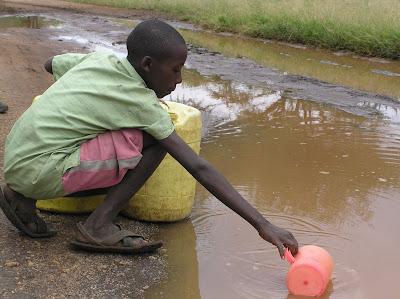
Water Woes in East Africa

A boy collects water from rain puddles in northern Tanzania.

Turn on your tap. Use the water. If you can do that, you are safer than hundreds of millions of people in Africa.